Objects of Religion
Religion has always been carried in things: hymnbooks, prayer cards, devotional textiles, sacred images, liturgical instruments, and other ordinary objects through which communities across time and tradition have practiced, transmitted, and contested belief. Objects of Religion brings together scholars and objects to ask what these artifacts can reveal about larger worlds of religious life. Each event organizes three scholars around a shared theme, with each contributor presenting one object as a way into the questions that theme pursues, beginning with careful description (what the object is, what it is made of, and what it shows) and moving outward to questions of circulation, feeling, discipline, or social relation. The series draws on the methods of material culture study and the history of religion to make those questions accessible to scholars, students, and general audiences alike. Digital entries expand the event series for communities beyond the university, accompanied by images, audio or video, and primary source links, turning each object into an open archive of interpretation.
Object Entry
Sabbath School Handkerchief
Boston Chemical Printing Company, Boston, Massachusetts
After 1837
Cotton, 11 1/4 x 11 1/4 inches
Library Company of Philadelphia, Art and Artifacts Collection, OBJ 897
Tags: devotion, education, ritual
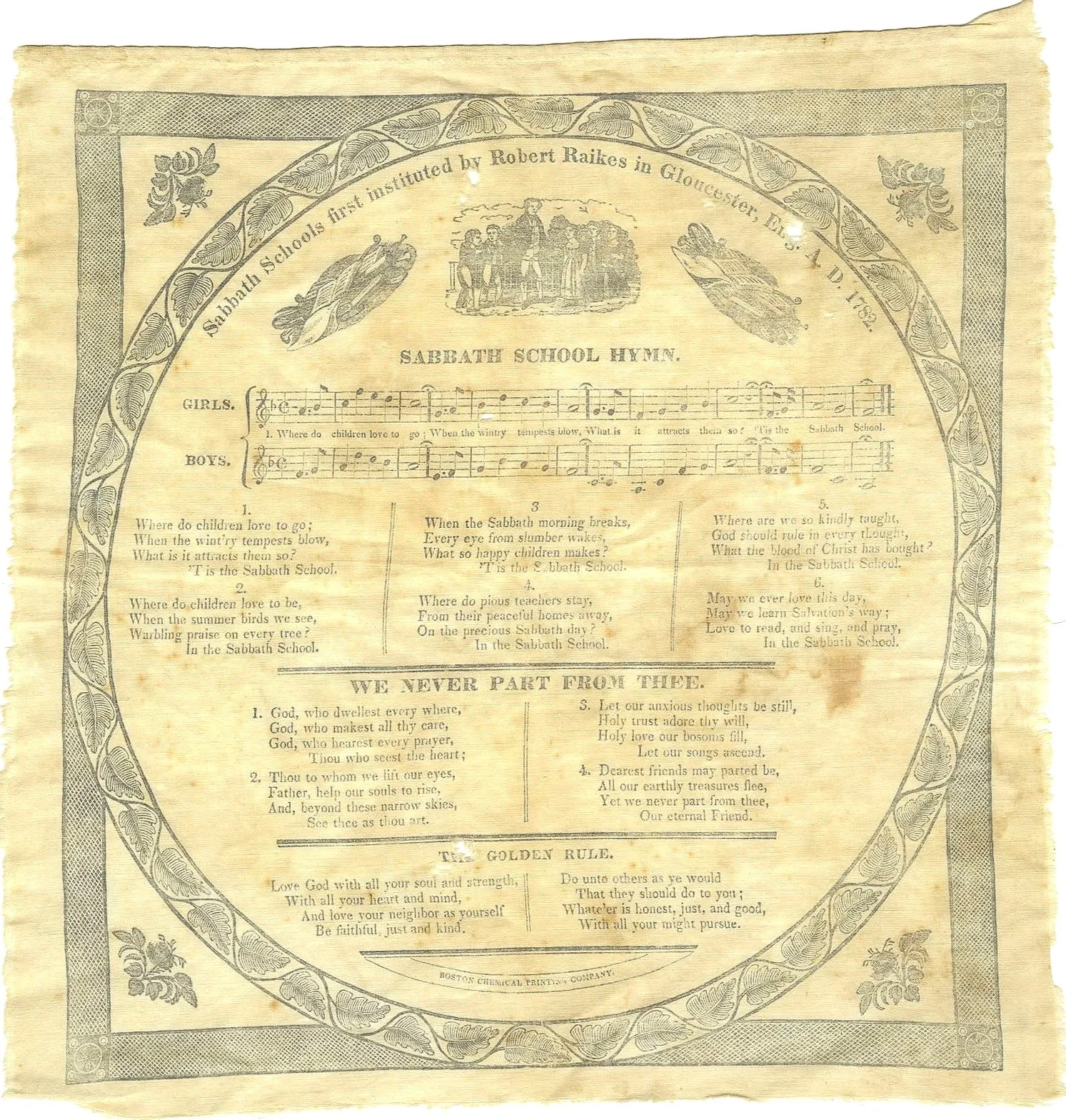
The Boston Chemical Printing Company pressed three hymns, two voice parts, and a founding myth onto eleven inches of cotton. The top edge retains its hem; the other three have come undone, leaving the fabric raw and frayed at the borders. Brown stains spread across the lower right quadrant, and small holes have worn through the cloth, perhaps from folding along the same creases over time. A dense border of leaves frames the outer edge; inside it, a wreath of the same foliage forms a circle that organizes everything the handkerchief contains. Curving along the top arc of that circle, following its shape, is a single orienting line: “Sabbath Schools first instituted by Robert Raikes in Gloucester, Eng. A.D. 1782.” At the center top, a small engraved vignette shows a teacher standing among children, open books flanking the scene on both sides. At the bottom, in small capital letters: “BOSTON CHEMICAL PRINTING COMPANY.” Other examples from the company's output survive at the Metropolitan Museum of Art and the Art Institute of Chicago, printed with moral verse by Hannah Flagg Gould.
Robert Raikes was an English printer and philanthropist who began gathering poor working children in Gloucester on Sundays (the one day they were free from labor) to teach them to read using the Bible and basic Christian instruction. His schools spread rapidly across Britain and, by the early nineteenth century, across the United States, where Sunday schools became one of the primary institutions through which Protestant churches reached children. Organizations like the American Sunday School Union, founded in 1824, standardized curriculum and flooded the country with cheap hymnbooks, lesson materials, and devotional ephemera. Printing Raikes’s name and date on this handkerchief gives the object a founding story, a transatlantic pedigree that placed every child who held it inside a long reform tradition.
Inside the circle, three hymns are arranged in a hierarchy the printing makes visible. “Sabbath School Hymn” commands the most space: two staves of notated music in F major, cut time, with the labels GIRLS and BOYS printed beside each staff so that the notation assigns bodies to parts and group singing becomes a structured exercise. Six stanzas spread across three columns below, each answering the question “where do children love to go?” with the same answer: the Sabbath School. “We Never Part from Thee” follows in text only, no notation, four stanzas in two columns: “God, who dwellest every where, / God, who makest all thy care, / God, who hearest every prayer, / Thou who seest the heart.” “The Golden Rule” closes in two stanzas, smaller still: “Love God with all your soul and strength / With all your heart and mind.” The first two hymn texts are in the same meter (7.7.7.5) and can be sung using the same melody provided; the Watts text is in common meter (8.6.8.6). The sequence moves from group singing to private prayer to commandment, from the schoolroom outward into the life a child leads when no teacher is watching.
The three texts come from very different worlds. “Sabbath School Hymn” is anonymous, set to a tune by Lowell Mason, the era’s most influential advocate for music as a tool of moral education, and first published in Mason’s Sabbath School Harp (Massachusetts Sabbath School Society, Boston, 1837), making the handkerchief roughly contemporaneous with its earliest known appearance in print. “The Golden Rule” is by Isaac Watts, from Divine Songs Attempted in Easy Language, for the Use of Children (1715), the founding text of Anglo-American children’s hymnody; by the mid-nineteenth century the collection had passed through more than a thousand editions, and its texts were a standard feature of Sunday school repertoire on both sides of the Atlantic. The text here is slightly adapted in transmission. “We Never Part from Thee” carries the most unexpected attribution: Eliza Lee Follen, a Boston Unitarian, abolitionist, and children’s writer closely associated with Lydia Maria Child, whose text survives in only two later hymnals, both published decades after this object.
The handkerchief is a tangible example of how religious formation worked, not only in the hour of Sunday school instruction but continuing in ordinary hours after, showing how the music and lessons traveled with children. Hymns were never merely content for Sunday school reformers; they were a delivery mechanism, designed to move doctrine into bodies and bodies into the world. The handkerchief is that ambition made textile, a curriculum mobile enough to fit inside a pocket.
Chase Castle
University of Wisconsin–Madison