“Sonic Domination and the Politics of Race in Southern Antebellum Hymnody.” Journal of the Society for American Music 17, no. 4 (November 2023): 383–405.

Steeple of the First Presbyterian Church of Port Gibson, which is topped with a gold-leaf hand pointing upward rather than a cross. Ben May Charitable Trust Collection of Mississippi Photographs in the Carol M. Highsmith Archive, Library of Congress, Prints and Photographs Division.
Religious music served a political function in the southern United States during the antebellum period. This article examines catechisms and hymnbooks used by white evangelical missionaries and slaveowners in the antebellum South, arguing that the planter elite deployed hymns as a medium to assert white supremacy. The term sonic domination identifies processes whereby sound functioned as a social tool to maintain discipline and order among the enslaved population. Black and white people sang hymns in church, at interracial revivals, and during civic services; they were also heard on bells and cited in poetry. English texts and tunes included in slave catechisms and white portrayals of Black singing highlight the role of evangelical hymns in maintaining plantation order in the Old South. At the same time, enslaved Black Christians found creative ways to circumvent the oppressive power of the white elite through song. African Americans employed English hymns in their own religious rituals and used them to convey hidden meanings on the plantation. Both genres, which interacted and ultimately influenced each other, contributed to an eventual codification of American evangelical hymnody.
“Ghost Stories of the Archive: Material Legacies and Writing Music History.” Pennsylvania Magazine of History and Biography 148, no. 3 (October 2024): 203–222.

Facing the pulpit at Rodney Presbyterian Church through broken windows. Photograph by Barbara Gauntt for the Clarion Ledger (October 17, 2019).
The infrastructure of American song contains many specters faded from public consciousness yet still present as moisture in walls. The screams of Aunt Hester, dancing of Jim Crow, silence of Venus . . . the unattainable and highly illuminating animated properties belonging once to the voices of enslaved African Americans. All these and more haunt American music, their dampened legacies intertwined with the weighted domination of capitalism, colonialism, and slavery. At the same time, these specters emphasize Black musical autonomy and how music shapes longstanding cultural identities, real or imagined. Analyzing sources as a form of historicized social practice shifts the very foundation on which African American music scholarship rests. The Rodney ghosts are disparate and fleeting, shifting our gaze across the diverse materials in which they reside. Their stories are each unique. These ghosts demand to be heard in their eerie silences, their vague tonal apparitions. Listening to them acknowledges the neglected marks of history.
“Soundworlds, Soundways and Audible Exchange.” Nineteenth-Century Music Review 23, no. 2 (August 2026): 426–435.
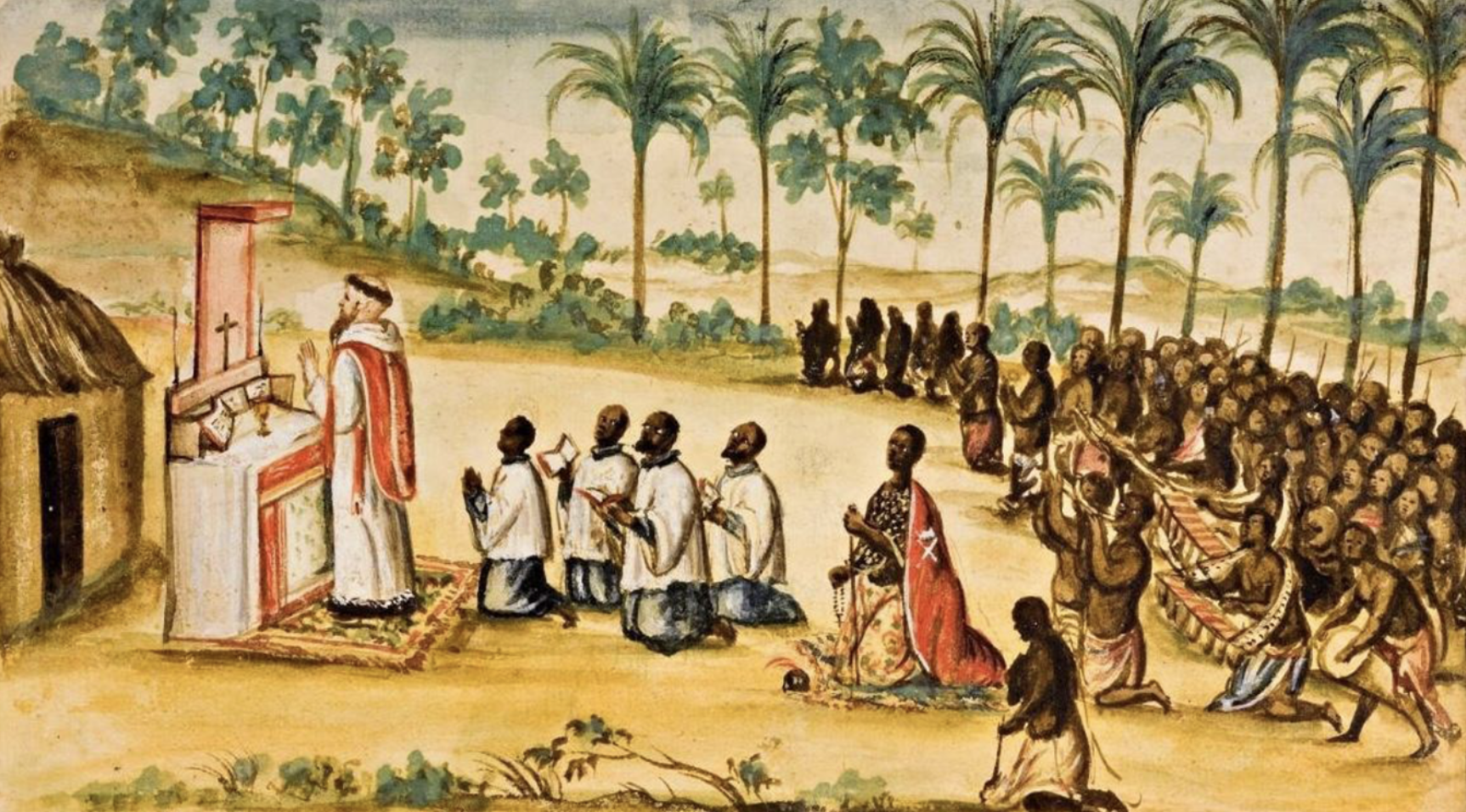
African musicians accompany the Mass behind a Roman Catholic priest, playing xylophones, ivory horns, and drums. Manuscript painting from Missione in prattica. Padri cappucini ne Regni di Congo, Angola et adiacenti, Central Public Library, Turin, MS 457.
Sound is social. It offers an entry point into worlds otherwise difficult to comprehend and renders listening a consequential mode of contact. Like reading a novel or moving through a gallery, listening situates people within diverse cultural practices that extend beyond the individual. Sound does not merely accompany social life but actively structures how relations are enacted, perceived and sustained. Listening is a mode of orientation through which people inhabit space, recognize authority and register belonging or exclusion. For nineteenth-century music studies, attending to listening offers a way to confront archives shaped by empire and enslavement. Music’s capacity to place listeners within social worlds, sometimes willingly and other times under duress, is central to understanding cultural exchange in early America. From Canada to the Caribbean, sound signalled labour and leisure, diplomacy and discipline, even devotion and healing. In these settings, listening became interpretive as much as experiential. Auditory practices were a potent form of encounter that spurred negotiation or resistance within deeply imbalanced power systems.